
Auto-published by Growwh – a smarter way to scale content and marketing. Want to know more? Chat with us.
Dhruva Space, led by Sanjay Nekkanti, is building a 280,000 sq. ft. satellite mass production facility in India to revolutionize the country’s satellite manufacturing sector.
Auto-published by Growwh – a smarter way to scale content and marketing. Want to know more? Chat with us.
When Sanjay Nekkanti began building satellites at just 19, India’s private space sector was almost non-existent. Motivated by the absence of satellite manufacturers in a country of hundreds of millions, Nekkanti chose the road less travelled to open the private space tech ecosystem in India. Today, as the founder and CEO of Hyderabad-based Dhruva Space, he is gearing up to launch one of India’s largest satellite mass production facilities — a sprawling 280,000 sq. ft. facility poised to transform the nation’s satellite manufacturing landscape.
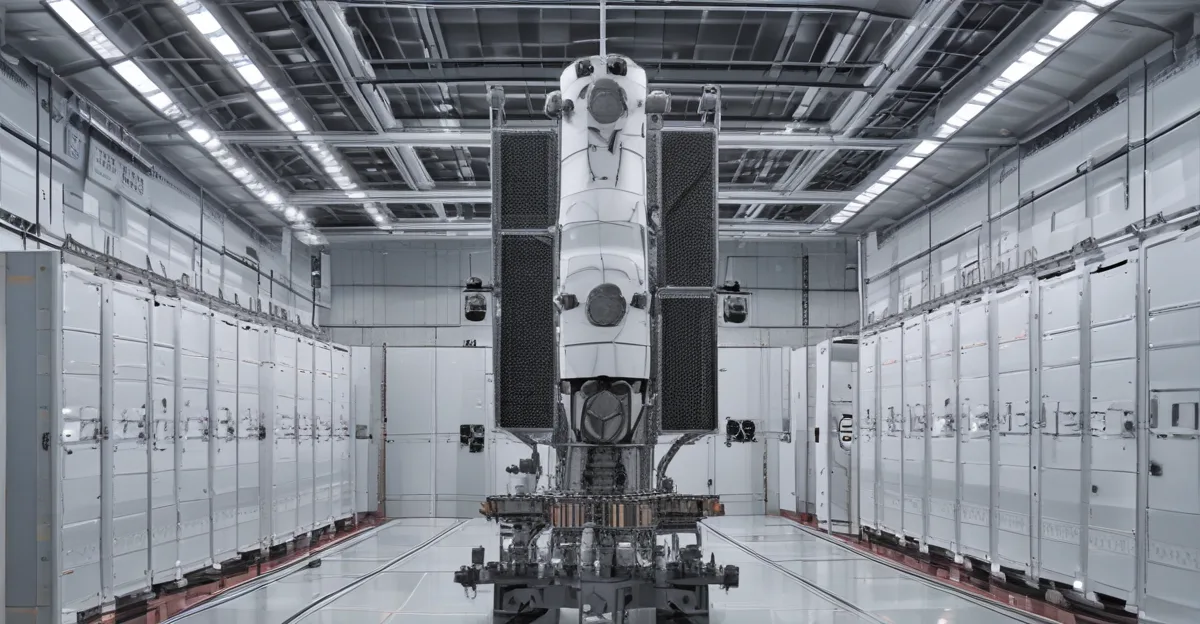
Dhruva Space’s upcoming facility in Telangana is designed to enable mass production of satellites through advanced assembly, integration, and rigorous testing. With capabilities to build satellites up to the 500 kg class, this infrastructure will be among the largest of its kind in India. This move addresses a critical gap in India’s space infrastructure, creating much-needed capacity for rapid satellite manufacturing.
Ready to take your brand to the next level?
At Growwh, we help startups and emerging brands grow faster with powerful content, creator collaborations, and tech solutions.
Explore what we do →
Though Dhruva Space remains vertically integrated, it collaborates with a network of over 500 vendors, and the new facility will amplify these partnerships by accelerating production capabilities to meet increasing demands.
Founded in 2012 by Sanjay Nekkanti along with co-founders Chaitanya Dora Surapureddy, Abhay Egoor, and Krishna Teja Penamakuru, Dhruva Space functions as a full-stack aerospace engineering company operating across the space, launch, and ground segments. It caters to a global clientele, including both civilian and defence sectors.
Initially focused on small satellites, CubeSat buses, and subsystems like orbital deployers, Dhruva has since diversified into modular satellite platforms (such as P-DoT, P-30, and P-Nu), the DSOD orbital deployer family, DSOL communications systems, launch integration, ground-as-a-service offerings, as well as commercial imagery and analytics.
This diverse portfolio has earned Dhruva notable international collaborations, pairing with firms like Kinéis and Comat (France), SatSure (India), Akula Tech and Esper Satellites (Australia), including a commercial mission with SpaceX Falcon 9 scheduled for the upcoming LEAP-1 mission. Concurrently, Dhruva maintains a close working relationship with ISRO via multiple PSLV launches.
Such expansion is underpinned by robust funding from government grants, venture capital focused on the space technology sector, and a significant Series A round attracting about Rs 123 crore.
What truly distinguishes Dhruva Space in the Indian space ecosystem is its vertically integrated business model combining the three essential segments: spacecraft manufacturing (space segment), launch coordination (launch segment), and ground services (ground segment).
“As satellite missions evolve from a handful to thousands, vertical integration provides greater control, faster turnaround, and higher reliability,” says Nekkanti. Stitching these pillars together allows Dhruva to streamline the entire lifecycle of satellite missions, improving efficiency and service quality at scale.
The new mass production facility is a critical step toward meeting the soaring demand for satellites serving use cases including Earth observation, communications, and more.
Among Dhruva’s breakthrough innovations is Solis+, a next-generation solar power module tailored for space applications. Unlike conventional panels, Solis+ enhances packing efficiency and features revolutionary revolvable arrays — a solution for deploying large-scale solar panels in orbit.
“Imagine trying to deploy a football field-sized solar panel in space — it can’t be one solid piece,” explains Nekkanti. The revolvable design enables flexible, scalable power generation optimizing payload capacity and minimizing launch weight, a crucial advancement impacting satellites requiring higher onboard power.
While Dhruva currently focuses on small satellites, it plans to scale production to accommodate satellites up to 500 kg, tapping into larger commercial and defence applications. Though not yet active in human spaceflight, the company expresses keen interest in contributing meaningfully to India’s ambitions in that domain.
Internationally, Dhruva has secured export contracts in Australia, the UAE, and Europe. It is collaborating with French firm Sodern, whose payload is expected to fly on a Dhruva satellite in 2026.
Dhruva also pursues moonshot projects and is actively exploring integration of cutting-edge technologies like artificial intelligence, quantum computing, and advanced manufacturing to elevate both satellite and ground-based operations.
“Space tech enables technology cross-pollination,” Nekkanti notes. “Deploying AI models onboard satellites, for example, can significantly improve operational efficiency and enable new space-based solutions.”
With a strategic blend of visionary leadership and robust infrastructure, Dhruva Space is positioning itself as a leading original equipment manufacturer (OEM) and service provider in India’s growing space technology sector. Its integrated approach, large-scale manufacturing capabilities, and international collaborations set the stage for a new era of satellite innovation in India.
“Space is a realm defined only by how far we choose to explore it,” affirms Nekkanti. “At Dhruva, we have developed technologies versatile enough for a wide range of applications. For us, the sky isn’t the limit — it’s just the beginning.”
Source
This article was auto-generated as part of a smart content campaign. Curious how we do it? Chat with us to learn more about our content automation systems.
This article was auto-generated as part of a smart content campaign. Curious how we do it? Chat with us to learn more about our content automation systems.
Discover more from Growwh
Subscribe to get the latest posts sent to your email.